Posts

How Annette Gordon-Reed Retold the Story of Sally Hemings and Thomas Jefferson
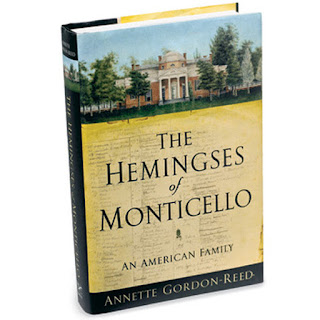
Image
In the preface to her 2008 book, The Hemingses of Monticello: An American Family , Annette Gordon-Reed argues that the titular family provide ideal subjects through which to view slave life because they “escaped the enforced anonymity of slavery” due to several reasons, among them being their ownership by a well-known historical figure; their existence at Monticello itself (a house that was built and maintained by the Hemingses); and the public knowledge of Thomas Jefferson’s sexual relationship with Sally Hemings during the time period it actually occurred. [1] In addition, the Hemingses were able to “achieve and maintain a coherent family identity that existed within slavery and survived it.” [2] The Hemingses of Monticello is breathtaking in scope, covering the lives of three generations of a slave family connected in both proximity and blood to arguably the most legendary of American founders.  However, up until Gordon-Reed’s publication of Thomas Jefferson and Sal...

From Jim Crow to Civil Rights: Reviewing U.S. Supreme Court History

Image
The current political climate in the United States is divisive and precarious, and it is not a historian’s job to explain it. What historians do best is look at the past, closely and contextually, to understand more about where humanity has been, which then perhaps can inform us about where we are going now . The history of the U.S. Supreme Court is a specific institution where a historian can analyze change over time in order to grasp the present and the future more effectively, especially with potential SCOTUS rulings on the horizon  with the potential to severely change America in the future. Most American historians—alas, most college graduates in the United States—should know the two famous court cases regarding segregation in America: Plessy v. Ferguson (1896) and Brown v. Board of Education (1954). In his 2004 book From Jim Crow to Civil Rights: The Supreme Court and the Struggle for Racial Equality , legal historian and constitutional law expert Michael J. Klarman ut...

An American in Assam (or the “Thrill of the Hunt”)

Image
How does a historian specializing in the American West find himself in Assam, India? If one finds themselves in such a predicament, do they do archival work the same as the United States? I have thought often of these questions before and after I left the U.S. on August 17, 2019. Having received the notification from the Fulbright Program that I had been selected to research the history of the British Raj in Assam, panic began to set in. Although I knew my way around different U.S. archives (big/small; general/specialized; near/far, etc.), I had never ventured out of the safe confines of my own country. Actually, this fellowship marks the first time I had ever left North America. I began to wonder if I would be able to “make it” in such a different environment. One of the many legacies of British colonial rule is their archival systems. The National Library and the National Archives spawned from British efforts to save every scrap of paper and book written about their efforts ...

Public History Q&A: How to Share the Past with the Community

Image
Many people do not notice the differences between “traditional” history and public history. This month we present a Q&A session with MJ Vega on how public projects get done and some of the challenges involved with bringing the past alive for a modern audience. Prior to starting graduate school at Washington State University, MJ created and now maintains a website dedicated to the public history of his high school football team. This is the brief story of how that project happened. Q: What got you interested in doing this kind of project? Why the history of this particular high school team?  A: I was born and raised in Monroe, WA, so it’s something I already have some familiarity with. When I was growing up in the 2000s, I would always hear about the team, so I just assumed we had always been bad, because no one had said anything to the contrary. But when I started going to Monroe High, the program started to turn around. I still didn’t follow the team much, but in my...

"A Beginning for Other Women": The Marital Rape Exemption and the Rideout Case

Image
On March 17, 2017, an Oregon man named John Rideout received a sentence of more than sixteen years in prison for rape and sodomy. His two victims, a woman he knew from church and his ex-girlfriend, spoke before a judge at the Marion County courthouse before sentencing; one said she hoped Rideout received help, while the other declared, “I am a victim no longer.” [1] Addressing the court, Rideout maintained his innocence, and then stated he was proud of his accusers, because they “stood up to me.” [2] Nearly forty years earlier, another woman stood up to Rideout: his former wife, Greta. On October 10, 1978, Greta Rideout, then 23 years old, telephoned the Women’s Crisis Center in Salem, as well as the Salem Police Department, alleging that her 21-year-old husband beat and raped her. She underwent a medical examination at Salem Memorial Hospital, where the doctor who examined her later testified she suffered from bruising around the left eye and cheek; her lips appeared bitten; an...